


Introduction to Revelation
Quick Overview of Revelation
Title: Revelation (The Revelation of Jesus Christ)
Author: The Apostle John
Date Written: Around AD 90–95
Audience: The seven churches of Asia Minor and the wider church of Jesus Christ
Setting: John received and recorded Revelation while exiled on the island of Patmos because of his testimony about Jesus Christ. The book was sent to seven churches in Asia Minor facing various challenges, including persecution, compromise, spiritual apathy, and pressure from the surrounding culture.
Purpose: Revelation was given to reveal Jesus Christ in His glory, encourage believers to remain faithful, and assure God’s people of His ultimate victory over evil. Through vivid visions and powerful imagery, the book calls Christians to worship Christ, persevere in faith, and live with hope as they await the fulfillment of God’s promises.
Key Verse: Revelation 1:3 (NKJV)
“Blessed is he who reads and those who hear the words of this prophecy, and keep those things which are written in it; for the time is near.”
Quick Links:
📖 Revelation Reading Plan
📚 Commentary Recommendations
▶️ Sermons
❓ Revelation FAQ

What Is the Book of Revelation About?
Revelation is the final book of the Bible and the climax of God’s redemptive story. It begins with a vision of the risen Christ walking among His churches and ends with God’s people dwelling forever in a renewed creation. Between these scenes, Revelation reveals God’s ultimate victory over evil and the fulfillment of His promises through Jesus Christ.
Many people know Revelation for its dramatic imagery—beasts, dragons, angels, judgments, and visions of the end of the age. While these images have fascinated readers for centuries, Revelation was not given merely to satisfy curiosity about the future. It was written to encourage believers to remain faithful to Christ, confident that God remains sovereign over history and that His purposes will ultimately prevail.
The book was originally sent to seven real churches in Asia Minor facing pressure, temptation, false teaching, and persecution. Through a series of visions, Jesus revealed both present realities and future events, reminding His people that He knows their struggles, walks among His churches, and will one day bring His plan of redemption to completion.
Revelation communicates through vivid symbols and imagery. Some details are challenging to understand, and Christians have long disagreed about certain aspects of the book. Yet its central message is wonderfully clear: Jesus Christ is Lord. Evil will not triumph. God’s judgment is certain. His people are called to faithful endurance. And one day Christ will return to make all things new.
For this reason, Revelation is not a book meant to produce fear or endless speculation. It is a book of hope. It calls believers to worship Christ, persevere in faith, and live with confidence as they await the fulfillment of God’s promises.
How Revelation Completes the Story of Scripture
The book of Revelation is not only the final book of the Bible—it is the conclusion of the Bible’s story. Themes introduced in Genesis find their fulfillment in Revelation as God brings His plan of redemption to completion through Jesus Christ.
From Creation to New Creation
The Bible begins with God creating the heavens and the earth. Revelation ends with a new heaven and a new earth where sin, death, sorrow, and pain are no more. What was broken by humanity’s rebellion is fully restored by God’s grace.
From the Garden to the City
Scripture opens in the Garden of Eden, where humanity enjoyed fellowship with God. Revelation closes with the New Jerusalem, where God’s people dwell securely in His presence forever. The tree of life, lost after the fall, appears once again in the new creation.
From the Curse to Restoration
Because of sin, the world came under God’s curse. Throughout Scripture, humanity experiences the effects of that brokenness. Revelation looks forward to the day when the curse is removed and God’s people enjoy the blessings of His presence forever.
From Promise to Fulfillment
Throughout the Bible, God promises to bless the nations, establish His kingdom, defeat evil, and dwell among His people. Revelation shows the fulfillment of those promises as Christ reigns in victory and God’s redemptive work reaches its glorious conclusion.
From Faith to Sight
For generations, God’s people trusted God’s promises by faith. Revelation points forward to the day when faith gives way to sight, when believers see the Lord face to face and rejoice in the fullness of His kingdom.
The Story Ends with Jesus
From Genesis to Revelation, the Bible tells one unified story centered on God’s saving work through Jesus Christ. Revelation reminds us that history is not moving toward chaos or uncertainty but toward the return of Christ, the defeat of evil, the resurrection of the dead, and the renewal of all things.
Major Themes in Revelation
- The glory and victory of Jesus Christ
- Faithful witness and Christian endurance
- The sovereignty of God over history
- Worship of God and the Lamb
- The conflict between God’s kingdom and the powers of this world
- God’s judgment of evil and injustice
- The certainty of Christ’s return
- The hope of resurrection and eternal life
- The fulfillment of God’s promises
- The new heaven, new earth, and New Jerusalem
Throughout Revelation, these themes are communicated through vivid visions, dramatic imagery, and powerful symbols. While Christians may disagree on the meaning of certain details, the book’s major themes are clear and provide a reliable guide for understanding its message.
A Guide for Reading Revelation
Revelation is one of the most fascinating books in the Bible. Its visions, symbols, and promises about the future have captured the imagination of Christians for centuries. Some readers are intimidated by its imagery and complexity, while others become so focused on the details that they miss the book’s central message. As you read Revelation, keep these principles in mind:
Remember That Revelation Is Meant to Be Read
Revelation begins with a blessing for those who read, hear, and keep its message. While some passages are difficult to understand, God did not give this book to confuse His people. Revelation was written to encourage believers, strengthen their faith, and give them hope in Christ.
Keep Jesus at the Center
The book is called The Revelation of Jesus Christ. More than anything else, Revelation reveals the glory, authority, victory, and return of Jesus Christ. As you read, pay attention not only to the events that unfold but also to the Savior who stands at the center of the story.
Pay Attention to the Big Picture
Some details in Revelation are challenging, and faithful Christians have reached different conclusions about certain passages. Rather than becoming overwhelmed by every question, focus first on the book’s major themes. Again and again, Revelation points readers to God’s sovereignty, Christ’s victory, faithful endurance, final judgment, and the hope of a renewed creation.
Expect Symbolic Language
Revelation communicates through visions, images, and symbols. Many of these draw upon the language and themes of the Old Testament. While some symbols may point to specific people, events, or realities, readers should avoid treating every detail as a code that must be deciphered. The symbols serve a larger purpose: revealing God’s truth and helping readers see the world from heaven’s perspective.
Look for Connections to the Rest of Scripture
Revelation is deeply connected to the rest of the Bible. Its imagery echoes themes found throughout Genesis, Exodus, the Psalms, Isaiah, Ezekiel, Daniel, Zechariah, and many other books. As you read, notice how Revelation brings God’s story to its glorious conclusion.
Read with Hope
Revelation contains warnings, judgments, and scenes of conflict, but it is ultimately a book of hope. The message of Revelation is not that evil will win or that the future is uncertain. Its message is that Jesus Christ reigns, God’s promises are sure, and those who belong to Him have every reason to remain faithful and confident as they await His return.

Beginning August 2, Revelation: How the Story Ends concludes our 2025–2026 theme, The Story of Scripture, by bringing us to the Bible’s grand finale. Over five weeks, we’ll follow God’s redemptive story to its climactic conclusion, discovering how the risen and reigning Christ calls His people to worship Him, remain faithful in a broken world, persevere through spiritual challenges, rest in the certainty of His victory, and live with hope as we await the day He makes all things new.
Revelation Sermons
24:43
23:39
28:47
22:44
22:30
Revelation 1: Introduction to the Book of Revelation
Turn to Revelation chapter one. Now, sometimes I try to help you find the books of the Bible, but Revelation is one of the easier ones. Just go to the very back. Find the last book of the Bible, and go to chapter one of Revelation.
And so we're going to be starting in verse one, and we're going to be reading the entire chapter, and we're going to be looking at it for an introduction to the book of Revelation. So please join me in reading Revelation chapter one, starting in verse one: the revelation of Jesus Christ, which God gave him to show his servants things which must shortly take place.
And he sent and signified it by his angels to his servant John, who bore witness to the word of God, and to the testimony of Jesus Christ to all things that he saw. Blessed is he who reads, and those who hear the words of this prophecy, and keep those things which are written in it. For the time is near.
John, to the seven churches which are in Asia. Grace to you and peace from him who is and who was, and who was, and who is to come. And from the seven spirits who are before his throne, and from Jesus Christ, the faithful witness, the firstborn of the dead, and the ruler over the kings of the earth, to him who loved us and washed us from our sins in his own blood.
And he has made us kings and priests to his God the Father, to him be glory and dominion forever and ever. Amen. Behold, he is coming with the clouds, and every eye will see him, even they who pierced him, and all the tribes of the earth will mourn because of him. Even so. Amen.
I am the Alpha and Omega, the beginning and the end, says the Lord, who is and who was and who is to come. The Almighty.
I, John, both your brother and companion in the tribulation and the kingdom and patience of Jesus Christ, was on the island that is called Patmos, for the word of God and for the testimony of Jesus Christ. I was on the spirit on the Lord's day, and I heard him behind me, a loud voice as a trumpet, saying, listen to this loud voice as a trumpet. Listen to what he says.
I am the Alpha and Omega, the first and the last. And what you see write in the book. And send it to the seven churches which are in Asia, to Ephesus, to Smyrna, to Pergamos, to Thera, Thyatira, to Sardis, to Philadelphia, and to Laodicea.
Then I turned to see the voice that spoke with me, and having turned, I saw seven gold lampstands, and in the midst of the seven lampstands, one like the son of man, clothed with a garment down to his feet, and girded up about the chest with a golden band. His head and his hair were white like wool, as white as snow, and his eyes like a flame of fire.
His feet were fine brass, as if refined in a furnace. And his voice the sound of many waters. He had in his right hand seven stars out of his mouth, and a sharp two edged sword, and his countenance was like the sun shining in its strength.
And when I saw him I fell at his feet as dead. But he laid his right hand on me, saying to me, do not be afraid. I am the first and the last. I am he who lives and was dead, and behold, I am alive forevermore. Amen. And I have the keys to Hades and of death.
Write the things which you have seen, the things which are, and the things which will take place after this. The mystery of the seven stars which you saw on my right hand, and the seven golden lampstands, the seven stars are the angels of the seven churches, and the seven lampstands which you saw are the seven churches. This is the word of the Lord. Thanks be to God.
Now you may have been able to already catch this idea as we are reading, for this revelation is something that when it comes to pastors, when it comes to Bible teachers and just anybody reading the Bible has kind of two polarizing reactions that often happen. One is some people just love it. They hear this imagery in it. It just speaks to them. And they want to know more in Revelation. They just want to talk about it all the time and get into all the details.
And many people, when they hear this, they think, what? I don't know. It seems that often these are the two responses, and sometimes pastors or teachers will just avoid Revelation altogether because it feels so tricky. How do you interpret this without getting into these really kind of complicated, debated things that when you look at it, every image is so full and robust and so it can be a challenge.
A challenge where sometimes we don't read Revelation at all because we're afraid of it, or we read it and we get lost in the weeds of our excitement about the images that we might lose sight of the big idea of the book of Revelation.
Now, my hope for you is that this morning, as we look at chapter one, we're going to come away with a strong grasp of what Revelation is about, the big idea that we're going to have some key things to be looking for when we read, so that all of us as we read Revelation, we can understand it at a level that we can apply to our lives, and that we won't be afraid of it and we won't get so distracted that we miss out on those elements.
If you look in your bulletin, you'll also see a link to on the web page. We have some more information for going deeper, so if you want to read some more introduction, I prepared an introduction page and some more information. Just go to Haven fellowship.org/revelation or follow that link down there in your bulletin. But you can find more there because we don't have time to get into everything this morning.
Jesus
But let's start with the key idea. The most important thing in Revelation. If you miss this, you're going to miss the Book of Revelation altogether. You're not going to understand any of it. And that key idea is Jesus. Revelation is about Jesus.
And if you don't believe me, I've got a challenge for you. Now you can do this in your Bibles. Don't do it in the pew Bibles, please, but take a pen and read through Revelation one again and circle every time you see Jesus. So if you see the word Jesus, circle it. If you see a title like the Lord or something, that's a title referring to Jesus, circle it. If you see a pronoun about Jesus, he, him, I, any of those things, circle it.
Do you understand the challenge? Probably, you need to do this at home. I'll show you my results. But you can do it for yourself and see it's up there on the screen. It's going to be a little hard to see, but do you see? There are on this page, a lot of little squiggly circles in my Bible software.
We can see the next one. This is the second half of Revelation chapter one. And here we have even more in total. Between those, I circled over 50 direct references to Jesus over 50 and one chapter with 20 verses. I think John is telling us his key point for this book, right?
But let's not even think about just the word Jesus. What about if a sentence is about Jesus? Because it could be talking about sharing the message from Jesus without saying his name, right? So don't do this one in your physical Bible. Please go through Revelation one in a digital copy or in your mind and highlight every sentence that is about Jesus. So if it's Jesus's message being shared, that's about Jesus. If Jesus is saying stuff, that's about Jesus.
Right here is my highlighting for, there you go. Literally every single verse in chapter one is about Jesus. And this is what I want you to understand about the book of Revelation. All of it is about Jesus. Every element, every image you see is going to be connected to Jesus.
We can see that here, right? We saw some different people. Let's look at verse one, the revelation of Jesus Christ, which God gave him to show to his servants things which must shortly take place. And he sent and signified it by his angels to his servant John. Who is John? Jesus' servant. Who are the angels? Jesus' angels. What is the message? Jesus' message. Are you catching this? It's all about Jesus.
And there are many details in the book of Revelation. There are things that we can look into, and they're going to be rich and they're going to be beautiful, and they're going to be helpful. But the most important thing is Jesus. Don't ever lose sight of that.
Let me give you an example. A few weeks ago, I went on a father son vacation. It was really nice. It took a few days with Caleb and we went out of town. The food vacation and so I planned a lot of restaurants, had to plan a hotel, so I did a lot of planning. I did a lot of details.
Now I want you to imagine if I had all of my bags packed and I checked off every item on my 500 point list, including reservations and all of that. And I showed up at the hotel and I pulled my bag out and there was no Caleb. Would that be okay? What do you need on a father son trip? A son and a father, right?
If Revelation is all about Jesus, we've got to remember that and to keep Jesus part of it.
Keeping Jesus Central
And so one of the challenges is the first questions we often ask are details, right. What does this mean? What does this represent? What is the timeline here? And those aren't necessarily bad questions. They could be helpful. But the core most important element is how does this relate to Jesus?
So let me just give you one example to kind of think through how we might do this. Let's think about the Mark of the beast and the number of the beast. So this is in Revelation chapter 13. Now y'all know the number of the beast. What number is that? One six. Six. Six. Right.
And people, they could look at this number and do a lot of thing. And the question that people always ask is what does this number mean? Who is the beast? And have you seen people do a lot of math work? Okay, I got to be a math wizard and I can figure out who is the beast that's numbered six six, six. What happens? And maybe maybe it's worth doing. I'm not trying to be too dismissive of that, but what happens if our first question is, how does this beast relate to Jesus? How does this number relate to Jesus?
Well, let's think about it. The number six, six, six is describing the beast. What number is Jesus described as? What is the number that would describe God or Jesus? And, the book of Revelation seven. It's a number of perfection, of holiness, of completion. The angels cry out to God, holy, holy, holy. 777, right?
That this idea that Jesus is God in the flesh, holy, perfect. And as you read about the beast, you see that he's imitating many characteristics of Jesus, that he had a fatal wound and then was raised to life, that he's spreading and calling people to worship him, that he has dominion.
But what did we read about Jesus? That he is rightfully King. All dominion belongs to him. So when you see this number six, six, six, I think the first thing we should look at is how do the sixes relate to the seven to Jesus? That the beast is the figure who opposes Christ, who puts himself in the position of worship, drawing worship to him, drawing worship, as we see in the chapter two, the devil himself, that that is what the passage is fundamentally about, the opposition by the devil. For the beast that he raises up to Jesus Christ.
And that's the key principle, the key idea. And then as we get into the details more, they may help us to understand that picture. But if we miss that, that he is the one poses it, presenting himself as a Christ like figure, but not pure, not wholly, not complete, then we're going to miss what this whole section is about.
So that is the first idea is to focus on Jesus. And my suggestion is you can do this for every element of Revelation. Ask yourself, how does this tie into Jesus?
So if you see somebody who is opposing and who is doing bad stuff, ask how he is opposing Christ through persecuting his people, through drawing false worship. If you see something happening, you're going to see over and over that Christ is the central figure. So that's number one that Revelation is about Jesus.
Jesus Reveals to Us
Now let's move on to the second element. And if you're following in your bulletins, I've combined points two and three for time. So point two is this. That Revelation is about Jesus revealing to us. In Revelation, Jesus reveals to us.
Look with me at verse one again, the revelation of Jesus Christ. It's about revealing that, not just the name of the book. That is the point of the book. And this comes from a Greek word which is, basically the word apocalypse. That's how we would pronounce it in English. And we have that word too.
Does anybody know the word apocalypse? Have you heard it before? Do you know what an apocalyptic movie is? Do you have any examples? What would be an apocalyptic movie? Dune, Terminator, I think of Mad Max. That's my image of apocalyptic. It's this end of the world stuff. If there were nuclear bombs going off in America, we would call that apocalyptic scene, right? It would be terrible. It'd be the apocalypse.
That's what we think the word means is the end of the world destruction and all that. But in Greek, apocalypse means reveal. It just means to reveal. It means to uncover something and make it shown.
Now, maybe some of you have seen before a baby gender apocalypse. Anyone? Here's the way a baby, sometimes in English they call it a baby gender reveal. But a way a baby gender apocalypse is something like this. Like the mother and the father, they know the gender of the baby, and they want to reveal this to everyone else, presumably so that they can buy the proper presents or something like that. Right.
And so they prepare this special apocalypse for everyone, and maybe they take, like a present, a box or something. It's like, maybe it's black and there's a lid on top and inside is going to be a balloon that floats out. And whatever color it is that's going to tell you, whether it's a son or a daughter, they open up the balloon.
The moment they open up the box. It's the moment of apocalypse where they reveal what's hidden. And the blue balloon. What's up everybody? Cheers. It's a baby boy. Very exciting. Right? Nobody cheers for that. Or maybe they have a cake and they cut into it. And inside it's pink and it's a baby girl. And everyone really cheers this time. And they're like, well, who? Right. They're very excited. That is a baby gender apocalypse reveal.
That is what Revelation is about. And I apologize if we didn't get these slides exactly right to match the point change. But Revelation reveals.
And do you know what's neat about this? It's not saying that Revelation is a mystery to solve. It's saying that God is revealing to us the mystery, that God is making known. Revelation is not a book that's primarily about what is hidden. It's about how God has revealed to us things that used to be hidden. Before Revelation, we didn't know them, but now they've been revealed to us.
Revelation is also described as a prophecy. We read this in verse three. Blessed is he who reads and those who hear the words of this prophecy, and keep those things which are written in it, for the time is near.
It's a prophecy predicting the future. But did you notice that it says who reads? Who hears, and who keeps? Notice what it didn't say. He who figures out, solves, masters, calculates. No. Reads, hears, keeps. Revelation is Jesus revealing to us things that are to be done, to be kept, to be practiced.
Revelation is a revelation from Jesus to his church, to his servants. It came through Jesus, from God to Jesus to the angels, to John the Apostle who also wrote the gospel of John and the letters of John to the seven churches in Asia, which is like, modern day Turkey, not what we think of as Asia. And to us, to his servants for the purpose that we read and understand what God is revealing and put it into practice.
Let's consider our example. We had talked about the mark of the beast, the number of the beast. How could we understand and put that into practice? Well, we can understand that we see revealed in Scripture that Satan is opposing God's people. And we can see in the future there's coming a day when God is going to, at the end of time, that there's going to be a figure that rises up and does this in a real way.
But we know from Scripture, from Thessalonians, for example, that even today that Satan is at work in that way. And what does Satan want from his opposition? He wants people to worship him. He wants people to worship anything other than God. And so when we see and understand that, what do we do? We draw our worship to Christ alone, and we recognize the danger of following other things.
What about the Mark of the beast? The mark of the beast is designed to manipulate people so that they don't have that mark. They can't do business because people trust in themselves. They trust in money, and then they will turn from God because that's their foundation.
So how do we apply that in our lives? How do we hear it and keep it? By putting our faith in Christ alone, by recognizing when we're depending on our own financial stability as our foundation, and realize that that makes us easy to manipulate. We need to trust in God as our foundation.
And what about the number of the beast? We're told that there is an inauthentic one to come who's going to call for our worship. We need to know what's authentic. My understanding is that people who look at fake money, counterfeit money, they train by looking at the real thing because there's all kinds of different ways to fake it.
This is why calculating the number, the point is not that you can identify who the real Antichrist is, so you don't follow him when he comes. The point is that we know Jesus so well that we can identify every false, every false voice calling us to worship, that we recognize Jesus.
The way we apply that passage is we study God's Word so we can see and know Jesus, that we won't be fooled by those six, six, six though we want to imitate Christ, but are false. And that's true for the ultimate final day and the final Antichrist. But it's also true in every moment of our lives as believers focus on Christ in His Word.
How the Story Ends
And then finally, let's look at this last point how the story ends. Revelation is the revelation of that. Jesus reveals to us about how the story ends and this is such an important element.
Billy Graham the evangelist, he always described himself as an optimist. They asked him why are you an optimist? He said, because I've read how this story, Jesus wins, he's victorious. He is going to rule forever. And this is telling us how the story ends.
For example, in verse 19, it says, write these things which you have seen, the things which are and the things which will take place after this. Some people see this as kind of a breakdown of the book, but the idea is that Revelation has the things that are coming about the end of this age, when Christ will bring his final judgment and bring the new heavens and the new earth.
Verse seven tells us plainly. It tells us, behold, he is coming on the clouds, and every eye will see him, even those who pierced him. And all the tribes of the earth will mourn because of him. Even so. Amen. He is coming soon.
You know Revelation ends. Final verses. This the second to last verse, verse 20 and chapter 22. He who testifies to these things, that is, Jesus says, surely I am coming quickly.
So here's my suggestion. When you're reading Revelation, always make sure you read to the end. Don't stop in the middle and say, wait, who is this beast that we're reading about in chapter 13 into Mark? Make sure you read to the end because he is the one who opposes Christ. He is the false Christ. Close in appearance but very far in spirit.
But what happens if you read to the end? You'll see that the devil himself, that the Antichrist is going to be thrown into the pit of fire, that he's going to be judged. You see, the ending is very important to Revelation. That's why it starts with that in chapter one. And as you read, always keep looking to the end.
Revelation gives us hope because we know how the story ends. Now, I will warn you, Revelation hits some tough topics along the way. It's tough topics for us personally about the reality of our sin. And we're going to stand before God on Judgment Day, stand before the throne. And if our name is not in the book of life. And we are going to be condemned, how can we get our name in the book of life? Well, we've seen it right here to be washed in the blood of the lamb and made pure.
And so when we know how the story ends, we're reminded that we must turn to Christ for salvation. It talks on opposition and tribulation and struggle. You're going to read that throughout the book, but keep remembering the end. Jesus is coming soon to defeat all those forces of evil.
It talks about the struggles we face of loss and death. Keep reading to the end. Jesus is coming soon. Every tear will be wiped away. We will live eternally with Christ and new heavens and new earth in the presence of God Almighty through Jesus. Because Jesus is coming soon.
So I hope you'll read Revelation. I hope you all apply it to your lives, and I hope you will find the hope that Jesus is revealing. Because in Revelation, Jesus reveals to us how the story ends.
If you have your Bibles, go ahead and open them up to revelation chapter two. And if you don't have your Bible, then go ahead and grab one from the pew right in front of you and it open it up to revelation chapter two.
Last Sunday we read revelation one, and in that passage, Jesus told John to write these words to seven churches.
In chapters two and three, we're going to read the letters to each of those seven churches. But here in chapter two, we're going to see the first four.
I know your works, your labor of I know your works, your labor, your patience, and that you cannot bear those who who are evil. And you have tested those who say they are apostles and they are not, and have been found liars. And you have persevered and have patience, and have labored for my name's sake, and have not become weary.
So will you join me as we start reading and revelation two, starting with verse one to the angel of the church of Ephesus write these things, says he who holds the seven stars in his right hand, who walks in the midst of the seven golden lampstands.
A great church right? But keep reading verse four nevertheless. No, you're right, that is a good church. It is indeed a good church.
Unless you repent. But this you have that you hate the deeds of the Nikolayev tense, which I also hate. He who has an ear, let him hear what the spirit says to the churches. To him who overcomes I give to eat from the tree of life, which is in the midst of the Paradise of God. Jesus continues to the next church in verse eight, and to the angel of the church of Smyrna write these things says the first and the last, who is dead and came to life.
But nevertheless they have something that Jesus holds against them picking up in verse four. Nevertheless, I have this against you that you have left your first love. Remember, therefore from where you have fallen, repent and do the first works, or else I will come to you quickly and remove your lampstand from its place.
I know your works, tribulation and poverty, but you are rich, and I know the blasphemy of those who say they are Jews and are not, but are the synagogue of Satan. Do not fear any of these things which you are about to suffer. And indeed, the devil is about to throw some of you into prison, and you may be tested, and you will have tribulation ten days.
Be faithful until death, and I will give you the crown of life. He who has an ear to hear, or he who has an ear, let him hear what the spirit says to the churches. He who overcomes shall not be hurt by the second death. As we move on, we see the third church, verse 12. And to the angel of the church of Pergamos write these things, says he who has a sharp two edged sword, I know your works where you dwell, where Satan's throne is, and you hold fast in my name, and did not deny my faith.
Even in the days in which Antipas was my faithful martyr, who has killed among you where Satan dwells. But. But I have a few things against you, because you have there those who hold to the doctrine of Balaam, who taught Balak to put a stumbling block before the children of Israel, to eat things sacrificed to idols, and to commit sexual immorality.
Thus you have also have those who hold the doctrine of the Nikolayev tense. Which thing I hate repent, or else I will come to you quickly, and I will fight against them with the sword of my mouth, who has an ear to hear. Let him hear what the spirit says to the churches, to him who overcomes, I give some of the hidden manna to eat, and I will give him a white stone.
And on the stone a new name written, which no one knows except him who receives it. Now as we come to verse 18, we have the final church of these four letters. Let's hear what the Lord has to say. And to the angel of the church. Church in Thyatira write, these things says the Son of God, who has eyes like a flame of fire, and his feet like fine brass.
I know your works love, service, faith, and your patience. And as for your works, the last hour more than the first, nevertheless, nevertheless, I have a few things against you, because you allow that woman Jezebel, who calls herself a prophetess, to teach and seduce my servants to commit sexual immorality and to eat things sacrificed to idols. And I gave her a time to repent of her sexual immorality, and she did not repent.
Indeed, I will cast her into a sickbed, and those who commit adultery with her into a great tribulation, unless they repent of their deeds, I will kill her children with death, and all the churches shall know that I am he who searches the minds into hearts. And I will give each one of you according to your works. Now to you, I say, and to the rest of Thyatira, as many as do not have this doctrine, who have not known the depths of Satan, as they say, I will put on you no other burden, but hold fast what you have, till I come.
And he who overcomes and keeps my works until the end, to him I will give power over the nations. He shall rule them with a rod of iron. They shall be dashed to pieces like the potter's vessel, as I also received from my father. And I will give him the morning star. So hear this refrain one more time.
He who has an ear, let him hear what the spirit says to the churches. Will you join me in a word of prayer? Heavenly father, I pray this morning that we have ears to hear. Lord, open our ears to your word and open our hearts to receive what you have for us, that we may keep it. We pray this in Jesus name, Amen.
The Call to Faithfulness
Well, we have here four churches and quite a few lessons we can take from them. The big thing, of course, is that God is speaking to these churches, and he's calling them to remain faithful.
Faithfulness Requires Truth and Love
Did that come through to every church that that as they are being faithful to God, they're being commanded and told to keep in that?
But as they've turned away from faithfulness, God calls them to repent and turn back to faith and faithfulness in Jesus Christ. And so what does faithfulness look like?
Ephesus: Truth Without First Love
There are a few principles I want to draw our attention to, and the first is that faithfulness requires both truth and love. It's not an either or thing, it's a both thing.
It requires truth and love. And for this, I think the first and the fourth of these churches really illustrate this point pretty well. That they both have something to commend, but they lack something that they need. And so God tells both of them to be complete and full by having both truth and love. So let's consider Ephesus. They were a church that had a lot going on.
Did you hear what a great sounding church this was? All of this stuff, it was very good. Right? And it sounds wonderful, but one of the characteristics they had, which Jesus praises is one that is unusual to praise and are culture. They had the spirit praised Jesus Christ, praised good quality of in tolerance. Did you notice that? I mean, look at verse two.
He's praising them. In verse two, I know your works, your labor, your patience. Those are all good things, right? What about this and that? You cannot bear? You cannot tolerate that you cannot stand, that you cannot have in your presence, that you cannot bear those who are evil. And you have tested those who say they are apostles and are not.
And you have found them liars. Do you see what Jesus is praising them for? Because they take the truth of God's Word, the truth of the gospel, and they cling to it, and they hold on to it. And they want their church to be known as a place that speaks truths. They want the teaching that comes from their pulpits, that comes from their teachers.
That's taught in their midst to correspond with God's truth, not false gospels. And so they test. They look at those who are teaching and they say, does this match what God is saying?
Thyatira: Love Without Truth
I hope, or that way I hope. You have a critical eye to me, that when I when I stand here in the pulpit and you say, well, I appreciate Josh saying that, what's the Bible say?
And if I ever misstep, I hope you come to me and say, hey, I think you missed it here because we want to be a church that does that, that tests what is true. And then did you notice that Thyatira what about them, that they had much to commend? They were a wonderful church. But what did they do?
Well, they tolerated things that were not true. They did not hold fast to the teaching and practice that corresponds with the truth of Scripture. Did you notice what it said? That Jesus feelings was for the Nicolay tense, that he hated their teachings? Maybe this is odd to you. We think of Jesus and we don't think of hatred necessarily, but he hated the false teachings.
Why False Teaching Harms People
Let me ask you this. How do you feel about scams that target senior adults?
I hate those scams. They're low life. Those are low down. What do you think about institutions that allow abuse of children? I hate that type of institution. And so do you, right?
Truth is the type of thing we want to cling to. God wants his church to be true because false teaching harms others. When you mislead people about how to be saved, what the gospel is. Some people will not experience salvation when you mislead people about what it means to live for God. They're going to live pointless lives mired in the muck of sin rather than new lives in Christ that Christ has for them.
Because the things that cause harm and hurt others are the type of things that we want no part of. And our thought towards those is one of strong dislike of hatred of that type of thing, because it hurts and harms others.
Returning to First Love
And so hold fast to truth. And yet that was not all because Ephesus did that, didn't they? They did have pure doctrine. They did get rid of those false teachers, yet along the way they had forgotten love. They had forgotten their first love for Christ. They were doing the right things, but love was missing. And maybe you've seen this before.
People who they get the right teaching, but they're cold hearted, maybe even angry and mean to those around them. They've gone from hating what is wrong to hating the people who aren't perfect. Have you seen that? That love can be missing and ultimately their first love is Jesus Christ, who loved them first and who brought them the love of God.
That is their first love. And when we have the love of Christ, what does Jesus tell us? To love one another. This is not optional.
We need truth. We need to within our church. This is within our families, within our relationships as well. Have truth that in church, God expects us to look at what is true and understand that, but also to take it a step further that churches need to, when they have that truth, confront what is false, to confront when we are going astray.
Ephesus did not. Receive a message to keep doing what's right. And don't worry about their hearts or their attitudes. God wants both truth and love. And so as for today, as we hear this message about being faithful, I hope we're reminded that we need both of these things.
That's the beauty of a church, is that we have spirit filled believers who can work together to hear God's truth and to stand firm in it faithfully. We also must have love. Love for Christ, love for one another.
So the thinking is something like this. You want to have love and you want to have truth. So let's not have too much love that we we get too far gone and not too much truth that people feel too bad. But that's not what Jesus said here, is it? He told the church in Ephesus, you're doing great to be grounded in truth, but add love to that.
And sometimes, sometimes I think people try to combine these two with a Goldilocks approach. You know Goldilocks, right? It's like just the right amount.
And he told the loving church that had acts of love but not truth. He told them to keep loving just as much as you are. Keep doing that, but make sure that your church is a place of true gospel and true teaching from God's Word. We need both, not a balance between the two. So that is the first lesson we see from these churches that faithfulness requires truth and love.
Faithfulness Requires Endurance Without Compromise
Faithfulness also requires endurance without compromise.
Smyrna: Enduring Tribulation and Poverty
The Third Church. See if I can find the correct one. The second church. The church in Smyrna. It's a good name. Right here in Haven. We're located on Smyrna Road.
This church is a church that's commanded and told to keep going, but they're not said you do this well, but I have this against you. This church is one of the two, premium pure churches, and the time has not turned away in any way. It is, I think we might say, one of the one of the two most faithful and two most blessed churches that we have here in Asia minor.
And do you know why people are named after Smyrna and not Pergamos or Thyatira? It's because this church is one of two churches in the Book of Revelation that has nothing negative to say about it, that Jesus has nothing negative to say about them.
And if you have if you've heard from, prosperity gospel type preachers who say that with faithfulness comes wealth, you might be expecting this to be the richest church right? Or maybe if you heard from word of Faith people that says, if you can put your prayers with strong enough faith, then you're going to not have any problems.
The reason you have sickness and problems is because you lack faith. Maybe you've heard that before, but let's take a look at this most faithful and most blessed church. This is in verse nine. I know your works. Tribulation and poverty. Do you catch that? The most blessed church, the most faithful church, is the one that is experienced in tribulation and poverty physically.
But Jesus adds, but you are rich. They are rich because of God's Spirit dwelling in them, that whatever comes their way, that they can have joy in the midst of hardship, that they're surrounded by persecution, yet they remain faithful. They have that thing that Paul talked about in Romans endurance. They have tribulation. They developed perseverance. They're enduring. They're keeping going.
And faithfulness to Christ requires endurance. This is the picture of what Jesus wants for all of us. Now, whatever life brings, whether it good or bad, that in all circumstances and all things that God will be enough and we will continue and persevere. This is a faithful church that finds endurance. We too, if we have ears, should seek to persevere in all that life brings.
Pergamos: Persevering Without Mixing with the World
But perseverance without compromise. You see, it's not just perseverance that matters. It is perseverance without compromise.
There are various things around them that could distract them, and they are persevering. They're keeping the name Christian, but they are compromising. They are compromising. In verse 14, we see that Jesus has a few things against them because you have there those who hold the doctrine of Balaam. That is the doctrine that's an Old Testament reference to a prophet who wanted to, prophesy against Israel, but he couldn't.
Look at the next church Pergamos because they in fact are persevering. They are going through persecution. They're in a place where it's like God, the capital kind of the Roman religion within the Asia province of Rome. There's a temple to the Emperor, to the goddess Roma.
And so in the most famous incident, he's stopped from doing that. But later he gives some advice. He tells them, here's what to do. I can't prophesy against them and hurt them, but you can have them intermarry with the other women, and then they will lose the blessing because they've abandoned their commitment, their faithfulness, their covenant to God.
So they embrace that type of teaching. What they've done is they've intermarried, as the people in the Old Testament had with the ways that the world around them. They've persevered by being called Christians. They've persevered by continuing to go to church on Sundays. They've persevered by remaining Christians, but they have compromised with the world around them. It's just like that glass of water that pastor and he put the dirt into.
It's still water, but some things are not made to be mixed. I know gas is expensive these days. How would it work to take the gasoline and mix it 5050 with water? David, you're a mechanic. How would that work? It would not work because some things are not made to be mixed, am I right? And Jesus is telling us that our faith in Christ is not meant to be mixed with the world or the culture around us as we persevere.
It's not merely keeping attending. It is staying faithful to Christ's message. Rather than mixing that message with the things that oppose it in the world around us. And so if we have ears to hear, we are reminded to remain faithful in this broken world. And we don't have a lot of time. So I'm not going to go into all the details.
Overcoming Through Christ
But there is another word that I want you to hear this word overcome. It's a Greek word, from which we get, brand Nike. So if you've got Nike shoes on, like Bradley, you know this word, and it means to be victorious or overcome.
And you can kind of see, like in my Bible software here. I did a word study on this, and I posted that study on the website. So you can read that, and I'll include that in my email out today. Or you can borrow this from me after, church, if you want the paper copy. But just listen to a few of these times that this word overcome is used in John's Gospel, his letters and in revelation.
And for each church, Jesus promised that they would overcome. I did a word study on this.
This is Jesus speaking. John 1633. These things I've spoken to you, that in me you may have peace. In the world you will have tribulation. But be of good cheer. I have overcome the world. And first, John, he writes, for whatever is born of God overcomes the world. And this is the victory that has overcome the world. Our faith in verse five.
Who is he who overcomes the world, but he who believes that Jesus is the Son of God? In revelation, it's going to look like later on that the beast overcomes revelation 11 seven. When they, the witnesses finish their testimony, the beast that ascends out of the bottomless pit will make war against them, overcome them, and kill them. It looks like all is lost, just as these churches are being told to remain faithful, but around them they see that some are persecuted and some of the churches seem to be falling, and it feels like the devil is winning.
But look at chapter 12, verse 11, and they overcame him. They overcame the beast by the blood of the lamb, by the word of their testimony. And they did not love their lives to death. Revelation 21 seven the last instance, he who overcomes shall inherit all things, and I will be his God, and he shall be my son.
Conclusion: Faithful by the Blood of the Lamb
Friends, we overcome by the blood of the lamb. We are called to be faithful, but not in our own strength. We are faithful by continuing to believe and place our faith and trust in the Lamb of God, Jesus Christ, who died for our sins. So let us have ears to hear that we may remain faithful as we continue to cling to Jesus and overcome through him.
August 30, 2026 Sermon Transcript
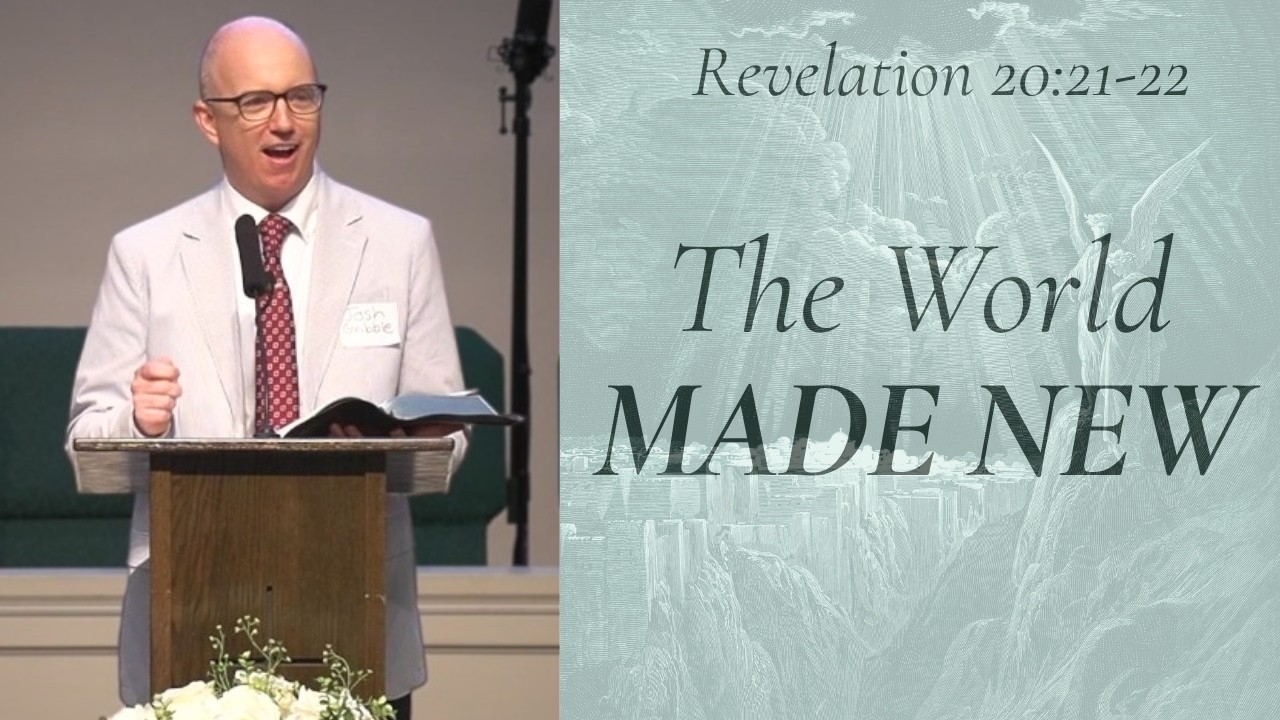
Revelation 21-22: The New Creation
Scripture Reading and Prayer
Go ahead and open up your Bibles to Revelation chapter 21. It's going to be one of the easier passages to find, because you can just go to the very back book. This is the second to last chapter, and we're going to be looking at chapters 21 and 22. I'll just be reading and we'll be reading together verses one through seven of chapter 21, and then discussing some of the elements in the next two chapters as we see the conclusion to the story of the Bible, but also this story of our lives and the future new creation that God will bring. So will you join me in reading revelation chapter 21? The first seven verses? Now I saw a new heaven and a new earth. For the first heaven and the first earth had passed away. Also there was no more sea than I. John saw the holy city, New Jerusalem, coming down out from heaven, from God, prepared as a bride adorned for her husband. And I heard a loud voice from heaven, saying, behold, the tabernacle of God is with men, and he will dwell with them, and they shall be his people. God himself will be with them, and be their God and God. Listen to this. If you are going through suffering right now, and God will wipe away every tear from their eyes, and there shall be no more death, nor sorrow, nor crying, there shall be no more pain. For the former things have passed away. Then he who sat on the throne said, behold, I make all things new. And he said to me, write, for these words are true, and faithful. And he said to me, it is done. I am the Alpha and Omega, the beginning and the end. I will give of the fountain of the water of life freely to him who thirst.
He who overcomes shall inherit all things. And I will be his God, and he shall be my sign. Will you join me in prayer? Heavenly father, we thank you for your grace and love, and we thank you that you always keep your promises. As we've been following the story of Scripture this year, we've seen how many promises you had and the Old Testament and how Christ fulfilled those promises. We pray, God, as we read your continued promises, that we have that same trust and faith, knowing that you keep them, that you are good, and that you will do as you have said, that we might be filled with joy at what is to come, and that it might shape how we live today. We pray this in Jesus name, Amen. Now we started this story of Scripture a year ago, and we've been going through the Bible ever since. We started in the garden, and we've ended up back in a garden. We started with creation and now we are at New Creation. Isn't it amazing how God's plan for creation did not stop with sin, but it continues on, and that God has revealed to us where the story of all of the earth is headed. So let's start with the loving Creator God and a new garden. Now, do you remember how Genesis begins? In the beginning, God created the. Heavens and the earth, right?
It's a very classic scripture, but look at revelation 21 and what's to come. Now I saw a new heaven and a new earth. It's tying back in to Genesis, and very quickly this is going to transition into discussing a bride, a city and a temple. But it's introduced first as a new creation. And so this these first seven verses are a summary. And then we read through it and so let's look at that element of creation found in Genesis. Let's look at that element that ties this to a garden. And to do that I encourage you to flip over to chapter 22. That's where we're really going to see the details that relate to the garden itself, rather than the city, the bride or the temple. And the first thing we see is that there is a river of life. There is a river in the garden. If we flip back to Genesis, you may want to have like a bookmark or a finger in two places. In this one, you might want to keep one spot saved in Genesis and one in revelation. And this is a detail I often miss. I'm told the story of Genesis many times, summarizing it for children, for youth, or even for adults. And as I tell this story, I talk about some of the typical things, right? A garden, a tree. Adam and Eve. I command not to eat from the forbidden fruit. A serpent. And of course, that act of rebellion and doing what God had not said.
But do you know what I almost, or maybe literally never talk about a river. But is a river an important element of this story? Well, look at Genesis chapter two, verse ten. Here we have a description of the Garden of Eden. Now a river went out from Eden to water the garden, and from there parted to become four river heads. And then it continues. There are five total verses describing the river. The river has more time describing it than any other element of creation or of the garden here. Now, why is that? What would what would the Garden of Eden have been like if there were no river? There'd be no garden. It would be the Desert of Eden, right? It would be the desolate land of Eden. There would be no life. Because in order for the the plants to grow, for the animals deliver Adam and Eve to live. They need a river. It brings life. And so when we get to the new heavens and new earth, what do we see but a river flowing? Look at 2021. And he showed me a pure river of water of life. Clear as crystal, proceeding from the throne of God and the lamb.
The river is this significant element. Why? Because just as the creation needed life, so too will the new creation be a vibrant garden. But it's not just physical water that sustains the earth. It is the water of life flowing directly from God Himself. It's a new creation filled with the life of God, just like the garden. Also in the garden is a tree and the new heavens and earth. What about back in the Garden of Eden? There were many trees. Adam and Eve could eat from them, but there were two special trees. Two supernatural trees, we might say. One was the tree of life. And Adam and Eve were invited to freely eat from this tree. But the other was the tree of the knowledge of good and evil. And they were forbidden to eat from this tree. But what happened? Adam and Eve. They rebelled against God, and they ate the fruit that had been forbidden. And with that, the garden was no longer pure and holy as it had been created to be. And so, as Adam and Eve were kicked out of that garden, they were removed. God made a special point. They could no longer eat from that tree. They could no longer eat from the tree of life. But what do we see when we're in revelation? What do we see in the new heavens and the earth? In chapter 22, verse two and the middle of its streets and on either side of the river was the tree of life, which bore 12 fruits, and each tree yielding its fruit every month.
The leaves of the tree were. The healing of the nations were for the healing of the nations. Do you see that the tree that was in the garden, that brought life, that tree the Adam and Eve could eat of, but not while sin was in the world. Well, now that sin has been removed from this earth, and the new heavens in the new earth are created, it's not just a single tree sitting there. In fact, it is a tree system that's on both sides of the river with enough fruit to never run out. There's never a season in the new heavens, in New Earth, where we do not have access to the life that God gives to us. His creation. The new heavens and the new earth are a garden with a river with a tree. There's one more element. It's what's missing. It's what's not in the garden. Because when Adam and Eve ate of that forbidden fruit, what came next? Sin came. God gathered Adam, Eve and the serpent. And he. There was a curse which came as well. The curse of sin. The consequences of sin. A curse that the earth had become fallen and broken. That humanity had become fallen and broken. And our relationship with God had been severed. What we had been created for was no longer good. This morning, as I saw this, story of scripture, word search, I had, of course, in my mind a rather good purpose for it. It was designed to entertain people as they found the words and somebody pointed out some of these words aren't there.
This has been poorly done. It's much like creation, isn't it? When we look at it, we can see its good purpose. And yet, if you look hard, or maybe don't even look hard at all, if you just casually glance at it, you see something is off. Something's missing. That's how creation is, isn't it? We can see the fingerprints of a good God, a God who created everything. And each day said it is good. And on the last day said it was very good. God has created a good creation. But sin marred that and destroyed not all of the goodness yet made its mark. That we live in a fallen and imperfect world. So what's missing from the garden? 22 three. And there shall be no more curses that this isn't saying. There shall be no more people using foul language. This is saying that the curse is in the Garden of Eden shall be no more, that the curse of sin is gone. This is continuing on. It says that there shall, be no need for the sun. There shall be no darkness there, because God will be the light. This is tying in to what we read earlier about how there are no seas in the new heaven and earth. They all represent the same thing. Chaos, sin. Destruction, death. Suffering, tears, pain. All of those shall be wiped away and not present in the new garden, the new creation which is fulfilling all that God had promised and created in the good creation. And if you've ever wondered if heaven is going to be boring, you know, spending eternity singing songs, that sounds rather boring.
Think back to how you have been created with a purpose, with a meaning just like this word search. It has a meaning and purpose, but it's only best fulfilled when it's without flaws. We too have been created to live in a good world, in a relationship with God. It's not going to be boring in heaven spending eternity. It's going to be living out the very purpose that God has made each and every one of us on a good, perfect earth with the God who we were made to be in relationship with. Now, as we look forward to this. We're waiting for that day, and we may hear as we're waiting for our lunch, some sounds. As people prepare as well. They're reminders that lunch is almost here. We see the same thing in Scripture, reminders that that new heaven and a new earth are coming. But let's look at a few more details as we do. And these are the details of a new temple. This is especially what you see in chapter 21 starting in verse nine. And there are three ideas all mixed together, but I think they climax in the idea of temple. Those ideas are a bride, a city, and a temple. And so let's look at those and very quickly track how they move from Genesis up to revelation to climax in the new heavens and the new earth. The first is a bride. We see this. In verses nine through ten. Then one of the seven angels who had seen that had the seven bowls filled with the seven last plagues came to me, and he talked with me, saying, come, I will show you the bride, the Lamb's wife. Now this is going to be described as a city momentarily.
From Creation to New Creation
But let's think about that image of a bride. In fact, this starts in Genesis. What is the story of Genesis about? The first thing God does is he looks at Adam, who is alone, and he says, it is not good for man to be alone. And he makes him a wife. And this is the picture of the covenant relationship between man and woman in marriage. But that picture is used to describe God's covenant relationship between God and His people. We see that throughout Israel throughout their history that they're often described as the bride of God. The prophets Jeremiah and Isaiah use that. Most clearly it's seen by Hosea, who is called to take a wife as a symbol of God's relationship with Israel, but he's called to take an unfaithful wife. Because Israel, God's people, had not kept the covenant. But did God give up on his unfaithful people? No, he did not. He pursued them. And so we see the Messiah who's come is the bridegroom. His first miracle at a wedding. But the hour had not come. The real wedding was going to be later, when Christ's return that we read in revelation. Jesus is the bridegroom. And we see throughout the New Testament that the church is the bride, the bride of Christ, who is the church? Who is the bride? It is the people of God, dearly beloved by him, united to God in relationship through Jesus Christ. Pictured as a wedding covenant and looking forward to the day when Christ's return that we read in revelation where we have that wedding feast and celebrate it with the bridegroom, Jesus Christ.
So the first picture is a bride. The second is that of a city. And we read that as we continue on. As we continue into verse ten. And he carried me away in the spirit to a great and high mountain. And he showed me the great city, the holy Jerusalem descending out of heaven. And some of you may be thinking, I've been talking about all of this starting in Genesis. There's no city in Genesis. And Genesis one, 2 or 3. And the Garden of Eden. Oh, but there is. If you were to drive up to the city of the Garden of Eden, it would have a sign that says, population two. It's a small city. But what was God's design for Adam and Eve? He told them to work the garden, right? To have dominion to do God's kingly role in the garden. And then what? Be fruitful and multiply and fill the earth. God's plan in Genesis was that that Eden would be the city from which God's reign and rule on earth would expand. That was broken by sin. But God's plan was not broken, because when he returns, that will come to pass. And we see this throughout Scripture. We see that God called his people a simple family. Abraham. He shouldn't have even been able to have kids. But miraculously, God blessed him and he did. It grew into a family which grew into a nation with its capital and Jerusalem, the holy city. God's reign and rule was meant to come through Jerusalem, but they often turned from God and did not live as his representatives on earth.
But Jesus Christ came the true King, that God's reign was here on earth in one person in Jerusalem. As a matter of fact, where he died on the cross, where he gathered believers on Pentecost as a people of God, the holy city. We read that we are already citizens of the heavenly city, and that heavenly city will come down. But right now we're also waiting for the day. And in revelation, we see the day that the people of God, the holy city, come to earth to live and reign with Christ. And one last element. And this is where it all comes together. The temple. Look with me at verse 22. Chapter 21, verse 22. And I saw no temple in it. Now, if we stop here, you may be thinking, this does not sound like a place where the temple. Right? No temple in it. But let's keep reading for the Lord God Almighty and the lamb are its temple. Do you know what the temple means? Here's a simple definition. A temple is the place on earth where God dwells, where the Holy God of heaven comes, and he dwells and meets with humans on earth. The first temple was in the garden. Why? Because God dwelt. He lived in the garden with Adam and Eve. Do you know what ancient temples would have in them? They all would have this in the center. They would have an image created in the likeness of their God. What do we find in the temple? What? In the Garden of Eden, man and woman created in the likeness and image of God, placed in the temple to represent their creator and live in relationship with him as he dwelt there among them with sin.
That relationship was broken, but God did not give up in the wilderness coming out of Egypt. He created the tabernacle, God's tent, his dwelling place with them through Solomon. The physical temple was built, a magnificent building to serve as God's house where he dwelt on earth. And the dimensions of this are pretty cool. They're set up as a square or a cube for the math people. They are the same width and depth and height. Well, what about this city that comes down from heaven? The city where there is no physical temple. It is in the same shape. If you read the dimensions of this temple, you're going to find that it is exactly set up as a square with the same width and depth and height. Because the city, the bride, the people of God, the new heavens and new earth are where God will dwell eternally with his people. There's no need for a physical temple, because all of creation is the temple, that God is the temple because he is dwelling in harmony with restored and holy people, made holy by the blood of the lamb, by Jesus Christ. And our meal is coming soon and so is Jesus. He wants you to know that he really does because this ends. But then as you continue on, you're going to see over and over again the same phrase. It must shortly take place. Behold, I am coming soon. It's repeated over and over again that every believer is to look forward to that day, but live each and every day of our lives with anticipation, so that when we suffer, we can say, the day is coming soon.
When we get distracted by things of this earth that don't matter, we say the day is coming soon. When we think that all that matters is the things around us, we say the day is coming soon and I'm going to live with joy in this earth in anticipation of Christ's return. And we have this invitation in chapter 22, verse 17, and the spirit and the bride say, come, let him who here say, come, and let him who thirsts, come. Whoever desires, let him take of the water of life freely. Friends, Jesus is coming soon and all are invited. This very day to prepare to meet him by drinking of the water of life, by believing in Jesus so that you can enjoy that glorious vision that we see here of what God will truly do as he brings us to eternal life. Let me close with this. These closing words. Jesus says, this is verse 20, surely I am coming quickly. Amen. Even so, come.
Scripture Reading and Prayer
Please grab a Bible. Maybe you have it on your phone. Maybe you have one with you. Or if you're with us in the room, the black books in front of you are Bibles. And open it up to Revelation chapter 20. We're going to be reading verses 7 through 15. Now, last week we were in the beginning of Revelation, as Jesus sent letters to seven churches, and we jumped across all of the middle of Revelation. So the seven bowls and the seven trumpets and the seven seals, we've jumped across the great beast and Babylon, and we have found ourselves at the end. Will you join me in reading Revelation chapter 20, starting in verse 7? Now, when the thousand years have expired, Satan will be released from his prison and will go out to deceive the nations which are in the four corners of the earth, Gog and Magog, to gather them together to battle, whose number is as the sand of the sea... Will you join me as we go to the Lord in prayer? Heavenly Father, we thank you for your great love, that you love the world so much that you sent your only Son, that whoever believes in him will not perish but have everlasting life. We pray this morning as we see your revelation of how all of history will end. We pray that you open our eyes and our hearts to your majesty and glory and splendor and victory, but also to your grace and love. We pray this in Jesus' name, Amen.
Christ the Victorious King
Now, last week we were looking at the churches of Revelation... Jesus called the churches to overcome. And how were they to do that? Why, it was through the great overcomer himself. Now, as we arrive at the end of Revelation, we see Jesus the King stepping in victorious as the conqueror. We see first that Jesus will stand in victory, and we see his victory over the devil.
The Devil Unmasked
Here in this passage, the devil who deceived them was cast into the lake of fire. Jesus is victorious.
I'm reminded of Scooby-Doo. Has anybody seen that cartoon? ... Revelation is doing something like that. It is pulling off the mask that is over the beast and over the systems that were at work in the first century and our day, revealing how Satan is at work in the world and that he will ultimately be defeated by Christ.
The Deception of the Serpent
What does Satan do? Satan deceives. Do you remember the first time we met the devil in the story of Scripture? He appeared as a serpent to Eve. And what did he do? Tried to deceive her. He said, “Did God really say?” The devil still speaks that way today, doesn't he? ... The deception of the serpent is to tell you that what God has told you is off limits is the exact thing that will make you happy.
The Victory of Christ
Even in that moment, God looked forward to the blessed victory found in Jesus Christ. As we look forward to the New Testament, we see Jesus' death on the cross where Satan received a fatal blow. In a very real way, on the cross, Jesus already was victorious over the serpent. The devil's hold was broken, sin's stranglehold on our lives was broken, and we could be raised to new life.
The Shortest Battle in History
If you're expecting the grand story of Scripture to come to a crescendo and a battle of equally matched foes between the forces of good and evil, you're going to be disappointed. The forces of evil have gathered. But look how it goes: “And fire came down from God out of heaven and devoured them.” That's the end of the devil right there, friends. It's short, it's sweet, and it's one transitional sentence to move you on to his final destination. The devil has been defeated. Christ is victorious.
The Great White Throne and the Two Books
As we look at how we will all stand before the throne and judgment, it all comes down to the books. The first books contain our works. The second is the Book of Life.
All of us have sinned and fall short of the glory of God. If we are depending on our own righteousness, we will stand condemned before the Lord. But there is another book, the Lamb's Book of Life.
The Lamb’s Book of Life
We can't earn righteousness through our own works, so we need to turn to the one who can give us his righteousness, Jesus Christ, the Lamb of God. Jesus came to earth and lived a perfect, sinless life. He died in our place so that we might be forgiven and made right with God. When we confess our sins and come to him in faith, our name is written in the Book of Life.
Final Invitation and Challenge
This passage calls us to respond. If you've never placed your faith in Christ, let today be the day that your name joins the saints in the Book of Life. And if you are a believer, the certainty of God's victory and the certainty that we will all stand before the throne should shape how we live each day. You see, Jesus is coming soon. Soon we will stand before the throne. And when we do, how will the King receive us?
Scripture Reading
Please grab a Bible. Maybe on your phone, maybe in the pew rack in front of you, but make sure you have a Bible in front of you right now as we read together, and please open it up to revelation chapter three. We're going to be reading this whole chapter. Last week we read the beginning of Jesus, letters to the seven churches. We read about the first four churches. And today we're wrapping that up with the final three churches who Jesus is sending letters to that they might have ears to hear what he says, that we might have ears to hear what Jesus says to us this morning. Will you join me in reading in revelation, starting chapter three, verse one? And to the angel of the church in Sardis write, these things, says he who has the seven spirits of God, and the seven stars, I know your works, that you have a name, that you are alive, but you are dead. Be watchful and strengthen the things which remain that are ready to die. For I have found your works perfect before God.
Remember, therefore, how you have received and heard. Hold fast and repent. Therefore, if you will not watch, I will come upon you as a thief, and you will not know what hour I will come upon you. You have a few names, even in Sardis, who have not defiled their garments, and they shall walk with me in white, for they are worthy. He who overcomes shall be clothed in white garments. And I will not blot out his name from the book of life. But I will confess his name before my father, before his angels. He who has an ear, let him hear what the spirit says to the churches, and we move on. This next church is one of the two faithful churches in revelation verse seven. And to the angel of the church in Philadelphia write these things, says he who is holy, he who is true, he has the key of David, he who opens and no one shuts and shuts, and no one opens. I know your works. See, I have set before you an open door, and no one can shut it, for you have a little strength.
But I have kept my word, and have not denied my name. Indeed I will make those in the synagogue of Satan who say they are Jews, and are not, but lie. Indeed, I will make them come and worship before your feet, and to know that I have loved you, because you have kept my command to persevere. I will also keep you from the hour of trial, which shall come upon the whole world, to test those who dwell on the earth. Behold, I am coming quickly! Hold fast what you have, that no 1st May take your crown. He who overcomes, I will make him a pillar in the temple of my God, and shall go out no more. I will write on him the name of my God, and the name of the city of my God, the new Jerusalem, which comes down out of heaven from my God. And I will write on him my new name, he who has an ear, let him hear what the spirit says to the churches. Now to the final of the seven churches, the lukewarm church in verse 14, and to the angel of the church of the layout of sins. Write these things, says the Amen, the faithful and true witness.
The beginning of creation of God. I know your works, that you are neither hot, that you are neither cold nor hot. I could wish you were cold or hot. So then, because you are lukewarm and neither cold nor hot, I will vomit you out of my mouth, because you say, I am rich and I have become wealthy, and I have need of nothing. And do not know that you are wretched, miserable, poor, blind, and naked. I counsel you to buy from me gold refined in the fire, that you may be rich and white garments, that you may be clothed, that your shame of your nakedness may be not be revealed. And anoint your eyes with the eye salve that you may see. As many as I love, I rebuke, and I chasten. Therefore be zealous and repent. Behold, I stand at the door and knock. If anyone hears my voice and opens the door, I will come in to him and dine with him, and he with me. To him who overcomes, I will grant to sit with me on my throne, as I also overcame and sat down with my father on his throne.
He who has an ear, let him hear what the spirit says to the churches.
Prayer
Will you join me in prayer? Heavenly father, we come to you this morning and we confess. We confess that at times we too can become lukewarm. We confess. At times we can become drowsy. To your truth, that we can be lulled into looking at things that are unimportant things, temporary things of this world, and forget the eternal things of your kingdom. We pray this morning that your Holy Spirit moves to wake us up. Your Holy Spirit moves to help us hold fast, that your Holy Spirit moves to open our eyes to see, and our ears to hear that we may be faithful to you. We pray this in Jesus name, Amen.
Introduction
Now I'm curious if I'm the only one, but has anybody else ever fallen asleep in class? Yes. Now we've got some students here now, right? Like you don't have to think back too far. Maybe it was this past week. Maybe another year. Have you ever got drowsy and started to fall asleep during class? I heard somebody over here shout out yes! Real loud. I'm seeing a hand. It happens sometimes. Now it happened to me one time, when I was in college. And some of you went to a really big school, and you're thinking of this classroom with hundreds of students in it. You know, this big lecture hall where you can fall asleep, but it's kind of like church. It's not that big of a deal. But this was not one of those classes. This was a class on the Minor Prophets, and there were an entire four students in there. Oh, of which I was one. My head started getting heavy. You know that feeling? It's like your chin just keeps dragging down. And my eyes started and I'm just, like, trying to hold them open.
And I thought, I've got to stay awake. Otherwise my professor will see me because there's only four of us here. I didn't fall asleep. Everybody had a good laugh. My nickname was sleepyhead. For the rest of the semester. It wasn't that big of a deal. I wish I had a college professor more like my dad was when he taught he was a math teacher. He would walk around and if somebody got drowsy or started falling asleep, lift up a big stack of textbooks and drop them right on the desk. Boom. Wake up. That's what my dad would do. Jesus is doing something similar here in this passage. He's shouting out to the sleepy church is wake up! But it's not like that scene in my class where the professor's watching, and if we fall asleep, there's just a couple chuckles. No, Jesus is coming soon. And will he find us faithful and watchful when he arrives? Lives? Will we be falling asleep to the things of God and eternity, so that when Jesus returns, we're not going to be prepared for that moment? That's the scene. That's the wake up call to these churches that are becoming unfaithful or lukewarm. But it's also a message of hope and encouragement to the churches that need to hold on.
Wake Up!
So we're going to start this morning by looking at the church in Sardis. And if you've been following along in these seven letters we've read so far, and there's been a bit of a pattern that's been emerging, Jesus usually starts by saying a compliment I know your works and you've done some good stuff, but this I have against you. Something like that. That's the most common pattern. And so when Sardis heard this, I wonder what they thought. Jesus said, I know your works, that you have a name, that you are alive. If there was a big pause there as the reader was reading this out, I wonder if the people in Stardust got a big smile. Oh yeah, we've got a name. All right. We've been working so hard at our reputation, at being known for our faithfulness.
We've got a name that you are alive. Yeah. That's us. Vibrant church, active church, busy church. We are alive. If this was written today, I think the social media team would be the most excited. That's what we've been working on. We've been posting pictures, we've been posting reels, we've been doing everything so that everyone can see and know that we are alive. Church. The church with a name that everybody's talking about, even may have a brand guide to help them get their. And maybe some of us can be lulled into being tempted and thinking, this is what a healthy church looks like now, wouldn't it be nice isn't the thing that we really want to be at a church that has a name for being alive, and we think about those small country churches or those small churches full of senior adults where they show up day in and day out and read the Bible. But there's nothing particularly exciting. There's no reputation. Nobody in town is talking about them. And we think, well, that kind of church is not worth much. But what if we could be at a church that was exciting and alive?
But Jesus continued. He didn't stop here. He said, I know your works, that you have a name, that you are alive, but you are dead. Do you hear that? They had fallen asleep. They looked busy. They were busy on the outside. They had a name for the world around them to see. And yet they had forgotten Jesus. They had fallen asleep to the Lord. Jesus reminders they should not be focused on their name. They should be focused on his name. And they should be focused that Jesus would know their name, that their name would be in the Book of Life. That's where their name should be. And so Jesus reminds them to wake up and he tells them, that he will be coming soon. But this is a warning, a warning to be alert. He's going to be coming like a thief in the night. And you know the problem. And we can think of this. What happens if a thief arrives in your house is unprotected? You'll lose everything. Jesus is reminding them, just as Jesus taught in his earthly ministry. In the parables about a bridegroom who's away and he's returning.
But when he arrives, will people be ready about the servant who goes on, about the master who goes on a trip? But when he gets back, will the servants be ready like a thief who comes in the night? Well, the homeowner be ready. And Sardis can actually relate to this in their own community. Their city itself was full of these really big, strong walls, and it was on a kind of area that was hard to get to. They had never been conquered by an army showing up and beating down the gates or the walls, or lining up a bunch of ladders to climb over, you know, all of those normal ways. They had never been conquered that way, but they had been conquered twice. Here's how. Because the guards were not alert. It wasn't that the army beat down the walls. It was. They saw a place that the guards weren't watching. They just climbed right over, opened up the gates, and then they went because the guards were falling asleep on the job. And Jesus is telling the church in Sardis that they have fallen asleep, and they need to wake up because he is coming soon.
And what about us? It's easy, isn't it, to become focused on the things of this world. They are pressing matters. There are things that are important. But when they lull us into falling asleep to the things of God, we have that same need to wake up. We might ask ourselves, have we fallen asleep as a church, as individuals? Have we been so focused on our own glory that we've forgotten to give glory to God? Have we been focused on our own earthly needs? And what are we going to eat and what we're going to do, and how we're going to take care of ourselves that we've forgotten to seek first the kingdom of God and His righteousness. We need to ask ourself, Is the Holy Spirit moving in us today? With that same message he had for Sardis, warning us that Jesus is coming soon. So wake up! The next church, Philadelphia, has a very different church setting and a very different message. This is one of the two faithful churches in revelation. Do you remember the other one, Smyrna?
Sardis: The Sleeping Church
Now here's an easy way to remember it one. Philadelphia is the only city that makes any sense to us in America because we've got a Philadelphia, Smyrna is the name of our road. So if you want to remember the two faithful churches in revelation, remember Smyrna Road and Philadelphia, Pennsylvania, is that where that's located? I don't really know geography that well, Caleb. That's where you get it from. Is your dad. Philadelphia was a faithful church, one of the two faithful. But did you hear Jesus description of them? Do you hear what he said to them now was, I would expect some amazing kind of theology. You've you've just you've got all of your theology so good, some amazing work, some amazing strength of faith on display. But listen to what he says, for you have a little strength.
Not a lot, not even a moderate amount. You have a little strength. What's amazing is this faithful church is not praised for having a name that everybody knows about as far as we can tell, they are a small, not particularly influential church. They are in the midst of persecution. They're not overly affluent. They don't have all their needs being met. In fact, they have many needs that are not met. And yet they have a little. But that little faith that small or they have a little strength. I'm sorry, but that little strength is matched with something even more important. Because for all that they lack, they have the thing that matters most. They have Jesus. They have Jesus, and they have been faithful to him. Remember last week we saw a church that had kept the name of Jesus, that they had kept being Christians, but they had compromised with the world.
It's to be praised that they had not given up being Christians in the midst of persecutions, but compromise was a poison that ate at them that needed to be removed. But this church, Philadelphia, though, they just had a little strength. They had remained faithful and uncompromising. Jesus says, you have kept my word and not denied my name. They've remained true to Jesus, and that made all the difference. Jesus promise for them. Is a promise of victory. He promises that he is coming soon. And this is so different from the last church. Did you notice how Jesus said, I'm coming soon like a thief? Be prepared. It's a warning. But for this church, I'm coming soon. And he was going to be coming as a victorious king, bringing what crowns of victory. I think of our runners who ran yesterday. Does it get hard as you're running, folks? Is is it hard to keep persevering? And maybe some of you might even think I have just a little strength, but how is it when you approach that and you can see that finish line? Or maybe you're coming in your last lap and somebody yells, you're almost there!
Victory is close at hand. Jesus is almost here, so keep going. Hold on. Stay strong. Don't give up. Jesus coming soon is a message of encouragement for every believer who struggles. And maybe there's some of us in here today who are like Philadelphia, where we feel that we are not that strong, that I only have a little strength. Maybe we we look at others around us, we look at preachers on TV and think, I don't know the Bible like he does, or I don't know the Bible like this other person does. Maybe we look at those around us and we think, wow, look how they're good at everything, how they seem to be able to do everything in church. And I'm showing up and I'm trying, but I only have a little strength. I can't compare. Maybe we look at the people in the Bible, people like Daniel or Moses, and we think, oh, if I were like them, if only I were like that. And we begin to get discouraged, maybe we think if I were like Sardis, a church with a name, a church that looked alive, that's what I would really like for myself.
That I had a name, that I was alive. But friends, this is my encouragement to you. The blessing of revelation. One of the blessings of revelation is keeping the words of this prophecy. And what does that mean? That means when Jesus gives us a measuring stick, we use that. That means we take the measuring stick of the world of what success looks like for our church and our life, and we throw that away, and we take the measuring stick that Jesus gives. For this is what a faithful church looks like, and we use that. Here's the measuring stick. If you have a little strength, just a little. If you feel weak, if you hold on to Jesus, that is more than enough. That will give you an eternal crown that will help you find what Paul found. Strength in all circumstances. And second Corinthians he writes, and he said to me, my grace is sufficient for you, for my strength is made perfect in weakness. Paul continues, therefore most gladly I will rather boast in my infirmities, that the power of Christ may rest upon me. Therefore I take pleasure in my infirmities, in reproaches and needs and persecutions in distress, for Christ's sake. For when I am weak, then I am strong. That's exactly what's happening in Philadelphia. There are church with a little strength, but very, very strong because they have Jesus.
And now we turn to the last church of the seven. And it's the one with maybe the most familiar imagery of all seven. It starts off with Jesus saying he wishes that they were either cold or hot. And so this is to the church and lay out a see. He wishes that they were either cold or hot. And what happens when they're lukewarm? What does Jesus say he's going to do with them if they remain lukewarm? He's going to. Spew them, vomit them. Spit them out of his mouth. Now, many commenters, they look at the situation here in Lao to see they didn't have, good fresh spring so they would pump water and they've actually found some aqueducts with the piping to bring water in from nearby places. There were some hot springs, some great hot springs that were famous for their healing power, and they would pump that in. But by the time it arrived, it was full of minerals and it was lukewarm and good for nothing. And they also think about the cold springs, which were so refreshing. And so this is the kind of context that a lot of commentaries point to.
The the value of both hot and cold water. Yeah. The fundamental problem of lukewarm. Is that it was in between the two. However, I think the central thrust this may be the background, but I think the central thrust. Is that being in between fervent for God, on fire for God and opposed to God, where you're in that lukewarm middle is no place to be throughout Scripture and several other places, acts in Romans, the same word is used to refer to fervent, enthusiastic, maybe even genuine in an authentic faith. That's the type of faith that Jesus wants us to have. Real, genuine faith. But why would it be better to be cold, to lack faith altogether? Reality is sometimes we can see our need most clearly when it's a stark difference between the two. The most dangerous place to be is where you kind of have a problem, but not so bad that you have to face it. If anybody's ever struggled with addiction or known, friends or family who have, there is sometimes a reality that hitting rock bottom is better than being able to cope with your problem. Because once you do, once you recognize that I genuinely have a problem, you can no longer pretend you don't. And now you can look for help. That's exactly what Jesus says to them, isn't it?
He says, you think you are rich. Look at this. What does he say to them? He says, because you say, I am rich and have become wealthy and have need for nothing. What kind of church has a need for nothing? A rich church that doesn't need anything? Even Jesus and you do not know that you are wretched, miserable, poor, blind and naked. The problem with the lukewarm church is that they think they don't have a problem. They think as a church that they don't need God. They think as individual members of that church that they don't need God. And we can become like that too. We can have lukewarm faith where we're going through the motions, where we're showing up on Sunday, where we're dressing up in our Sunday best. We're we're taking care of ourselves. And we think that as we're living holy lives through our own efforts that we have done good enough. We've clothed ourself in righteousness. But no, we need the righteousness of Jesus Christ. He tells us to get that righteousness from him, the righteous clothes that he provides. And then he says, behold, I stand at the door and knock.
He's speaking to the whole church. Do you see the tragedy of this scene? Jesus is standing at the door of the church of loud AC knocking, saying, let me into your church. Any church where Jesus is standing on the outside knocking in. In fact, any church where Jesus is not at the dead center of your church, of your ministry, of your teaching, if Jesus is not the one leading and guiding, if Jesus is not the one you are worshiping faithfully. You are a lukewarm church who Jesus well spit out of his mouth. But this hard word of warning comes with an invitation. He's saying these words of discipline so that they can experience the love of Jesus coming in and eating with them. Any church that opens the door to Christ and makes Christ the center is going to be a church that thrives with what matters most, because Jesus will be present and they will have fellowship with him.
They will have the holiness of Christ in their presence. This is true for individuals too, isn't it? The same principle applies. All of us need Jesus and Jesus, just as he loved the church and he called for them to let him in. He loves us and he calls us to let him into our hearts as well. That if you've never believed in Jesus and received a new life that he offers, Jesus is standing there knocking, calling out to you, will you welcome him into your life through faith? And if you're a believer who's grown lukewarm, Jesus is standing there calling. Will you welcome him back in and receive the grace and love that he has? Now, we've seen three churches this morning, haven't we? They're all different, different situations, but they have a similar message message to wake up, to keep going and to don't settle for lukewarm faith this morning. How how do we hear what the spirit says to the churches? How is the Holy Spirit moving in your life that you might respond to his call, his call to wake up? It's encouragement to persevere. His warning of lukewarm faith. I invite you to live ready for Christ's return because Jesus is coming again soon. So live today. Ready to meet your King.
Frequently Asked Questions
Revelation is Scripture, prophecy, and letter.
It is Scripture because it is part of God's inspired Word. It is prophecy because it communicates God's message and reveals events connected to the fulfillment of His purposes. It is a letter because it was written and sent to seven real churches facing real challenges.
Revelation is also unique in that it records a series of visions Jesus Christ gave to John. John did not simply invent symbolic images to communicate spiritual truths. Rather, he faithfully recorded what he saw and heard. Throughout the book, some elements of the visions are explained directly, while others require careful interpretation. Understanding Revelation begins by recognizing that it is a record of divine revelation given through visionary imagery.
Christians have disagreed about some parts of Revelation for centuries. Because of that, our confidence should match the clarity of Scripture. We should speak most confidently about what God has made clear and most humbly where faithful Christians disagree.
For example, we can be certain that Jesus Christ will return, the dead will be raised, there will be a final judgment, salvation is found through faith in Christ, evil will be defeated, and God will make all things new. On other questions, such as the timing of the rapture or the exact meaning of certain symbols, Christians may reach different conclusions while remaining faithful to Scripture.
As we study Revelation, we want to hold firmly to what is certain and charitably to what is uncertain. A good principle is: Never let a "maybe" displace a "yes."
The answer is both.
Revelation literally records visions that Jesus Christ gave to John. For example, John literally saw seven lampstands, yet Jesus explained that the lampstands represented seven churches. The vision itself was real, but not every element of the vision was intended to be understood in a purely literal way.
Throughout Revelation, symbols, images, and visions communicate real truths about God, Christ, His people, and future events. Readers should avoid two extremes: treating every image as a literal description or treating the symbols as vague figures that can mean anything. The symbols are part of God's revelation and should be interpreted carefully within the context of Scripture.
The most basic answer is that this is how Jesus chose to communicate His revelation to John.
Throughout the book, Christ reveals truth through visions filled with imagery, symbols, and dramatic scenes. These symbols often communicate complex realities in vivid and memorable ways. They help readers see events from heaven's perspective and connect Revelation to themes found throughout the rest of Scripture.
Rather than asking why John used so many symbols, it is better to recognize that this is how Christ chose to reveal His message. The imagery is not a distraction from the message—it is part of the message.
Lorem ipsum dolor sit amet, consectetur adipiscing elit. Ut elit tellus, luctus nec ullamcorper mattis, pulvinar dapibus leo.
At Haven Fellowship Church, we understand Revelation as a prophetic vision given to real churches in the first century that ultimately points forward to the future fulfillment of God's purposes in Jesus Christ.
We believe Revelation contains meaningful symbolism and imagery while also speaking about real future events. We encourage readers to pay careful attention to the text itself, focus first on the book's major themes, and approach disputed details with both conviction and humility.
Pastor Josh generally approaches Revelation from a futurist perspective, believing that much of the book points forward to future events surrounding the return of Christ and the completion of God's redemptive plan. At the same time, Revelation continues to speak powerfully to believers in every generation.
Christians have generally approached Revelation in four major ways:
Preterist – Understands much of Revelation as referring primarily to events in the first century.
Historicist – Understands Revelation as symbolically describing the history of the church throughout the centuries.
Idealist – Emphasizes timeless spiritual realities and recurring patterns of conflict between God's kingdom and the powers of this world.
Futurist – Understands much of Revelation, especially from chapter 4 onward, as pointing to future events connected to Christ's return and the completion of God's plan for history.
Many Christians incorporate insights from more than one approach. At Haven Fellowship Church, we believe the futurist approach best accounts for Revelation's emphasis on Christ's future return, final judgment, resurrection, and the coming of the new heaven and new earth.
No.
The Antichrist—or, in Revelation's imagery, the Beast—plays an important role in the book's portrayal of opposition to God and His people. However, the Beast is not the central character of Revelation.
The central figure of Revelation is Jesus Christ. The book begins as "The Revelation of Jesus Christ" and consistently directs readers' attention to His authority, His victory, His kingdom, and His return. The message of Revelation is not ultimately about the rise of evil but about the triumph of Christ over evil.
The mark of the beast appears in Revelation 13 as a sign of allegiance to the Beast and participation in its rebellion against God.
Many believers fear that they might unknowingly or accidentally receive the mark of the beast. Yet that is not the picture Revelation presents. The mark is closely connected with worship, loyalty, and identification with the Beast's kingdom. Those who receive the mark knowingly align themselves with the Beast in opposition to God.
While Christians differ on some details regarding how the mark should be understood, the central message is clear: God's people are called to remain faithful to Christ and refuse allegiance to any power that demands the worship, trust, or loyalty that belongs to God alone.
The word rapture is commonly used to describe the gathering of believers to Christ described in passages such as 1 Thessalonians 4:13–18 and 1 Corinthians 15:51–52.
Christians generally agree that Jesus Christ will return, the dead will be raised, and believers will be gathered to Him. The primary disagreement concerns the timing of these events in relation to the events described in Revelation.
Revelation does not explicitly describe believers being caught up to meet the Lord in the air as Paul does in 1 Thessalonians 4. Instead, Christians draw conclusions about the timing of that event by comparing Revelation with other passages of Scripture.
Some Christians believe believers will be gathered to Christ before a future period of tribulation. Others believe the church will experience that tribulation before Christ returns. Still others understand the relationship between these events differently.
At Haven Fellowship Church, we affirm the future, visible return of Jesus Christ, the resurrection of the dead, and the gathering of believers to Him. While Christians differ regarding the timing of these events, all orthodox believers agree that Christ will return and His people will be with Him forever.
Ultimately, the purpose of biblical prophecy is not to create fear but to strengthen faith. Throughout Scripture, God repeatedly demonstrates His faithfulness to His people in times of testing, suffering, and tribulation. Sometimes God delivers His people from hardship, and sometimes He preserves them through hardship, but He never abandons them.
Whether Christ gathers His church before, during, or after a period of tribulation, believers can face the future with confidence. Our hope is not found in escaping difficult circumstances but in the promise that Jesus Christ reigns, will return for His people, and will keep His promises to the very end.
The number 666 appears in Revelation 13 as the number of the Beast. Christians have proposed several interpretations throughout church history, but many understand the number symbolically rather than as a secret code to be deciphered.
Throughout Revelation, numbers often carry symbolic significance. The number seven is frequently associated with completeness, fullness, and God's perfect purposes. In contrast, the number six falls short of seven and can be understood as a symbol of imperfection and failure.
Many interpreters therefore understand 666 as emphasizing the complete imperfection and evil of the Beast. The threefold repetition underscores the Beast's character as a counterfeit ruler who opposes God while seeking the worship and allegiance that belong to Christ alone. The Beast presents itself as powerful, victorious, and worthy of devotion, but its rule ultimately falls short of God's perfect kingdom.
While Christians continue to debate some details, Revelation's central warning is clear: believers must not give their allegiance to rulers, kingdoms, or systems that demand the loyalty and worship that belong to God alone. The Beast is a counterfeit of Christ, but only Jesus is the perfect King. Revelation repeatedly directs our attention away from false saviors and toward the Lord, who alone is worthy of worship.
Revelation warns repeatedly about deception. False teachers, false prophets, counterfeit signs, and worldly powers all seek to draw people's allegiance away from God and His Christ.
The best protection against deception is not fear, speculation, or endless study of every false teaching. It is knowing Jesus Christ through Scripture. The more familiar believers become with Christ's character, teaching, and gospel, the easier it becomes to recognize what does not belong to Him.
Christians can be misled by persuasive leaders, impressive claims, dramatic signs, or popular movements. Yet believers who remain grounded in God's Word, devoted to Christ, and dependent upon the Holy Spirit have a trustworthy guide.
Revelation ultimately calls us not to place our confidence in prophecy charts, personalities, movements, or extraordinary experiences, but in Jesus Christ. He is the faithful witness, the risen King, and the One who cannot deceive His people.
Unless otherwise noted, Scripture quotations are taken from the New King James Version® (NKJV). Copyright © 1982 by Thomas Nelson. Used by permission. All rights reserved.


